ScreenSnip

Screenshots that stay
on your machine.

A proper Windows capture tool. Scrolling pages, a real annotation editor, and search that reads the words inside your screenshots. Nothing is uploaded. There is no account.

Download for Windows Version 0.4.44 · 148 MB · 64-bit

Signed by 180 Degrees IT Solutions. Free while in preview.

Nothing leaves your PC

No cloud, no account, no telemetry. Your captures are files in a folder you chose.

Find it again

Tag a screenshot, or just search for words that appear inside the picture.

Redact properly

A blur that removes the pixels, not one drawn on top of them.

What it does

Capture anything on screen

Region, window, a single control, the active window, one monitor or all of them. Repeat the last region with one key.

  • Scrolling capture, down a page or across it
  • Freehand and multiple separate areas in one shot
  • Menus, which normally vanish the moment you click away
  • Delayed and time-lapse
  • Fixed size, when every shot has to match

An editor you will actually use

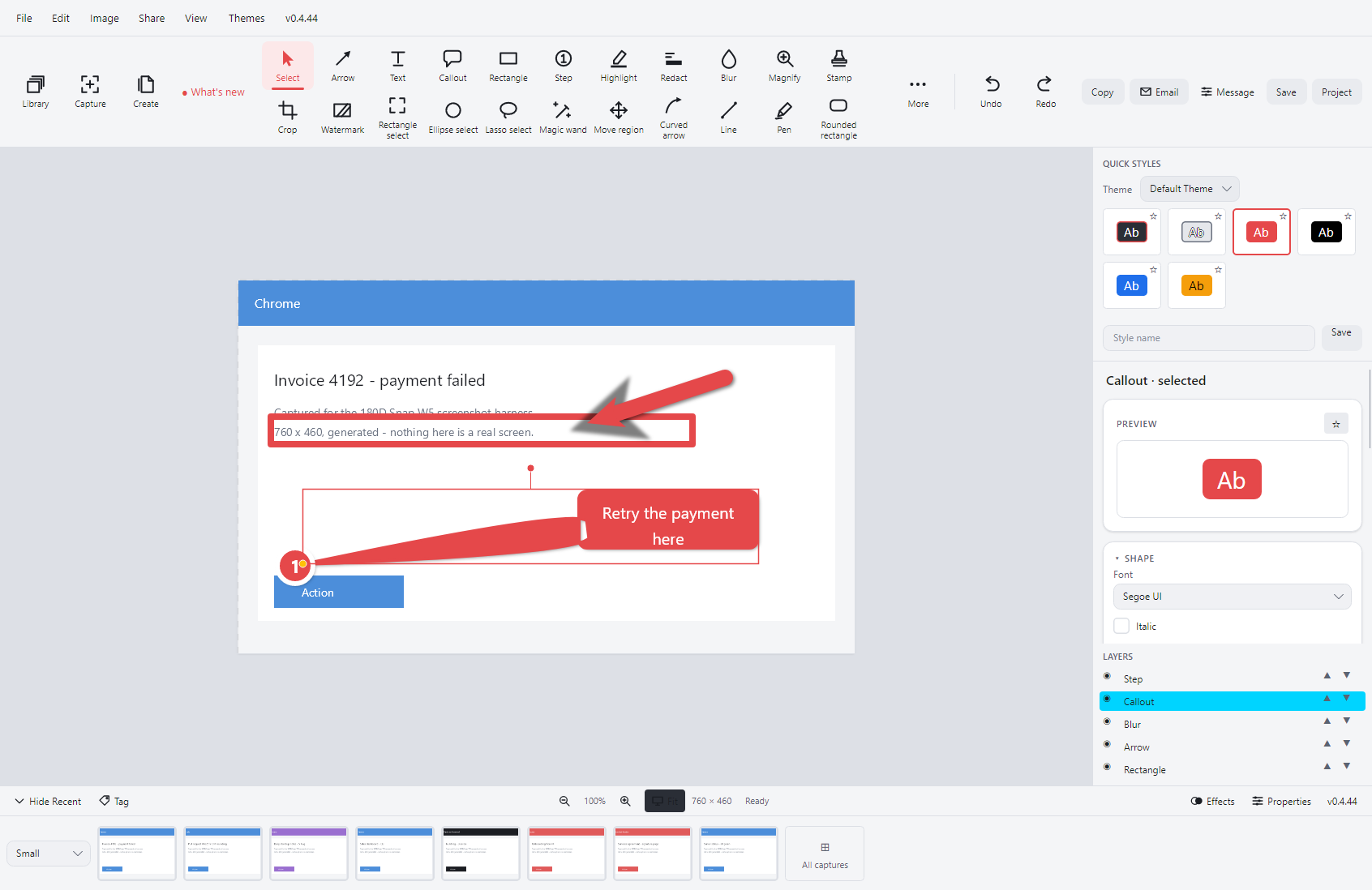
Twenty-odd tools, all of them editable after you place them. Nothing is baked in until you export.

  • Arrows, curved arrows, lines and every basic shape
  • Text, callouts and numbered steps
  • Highlight, spotlight and magnify
  • Stamps, a pen, and a drawn-in mouse cursor
  • Crop, cut out a slice, and move part of the picture

Redaction that actually redacts

Blur, pixelate and solid redaction destroy the pixels underneath rather than covering them. Anything the app read out of those pixels is thrown away with them.

  • Smart Redact finds the text for you
  • The search index is cleared for anything you redact
  • Cached thumbnails of the old pixels are discarded too

Search inside your screenshots

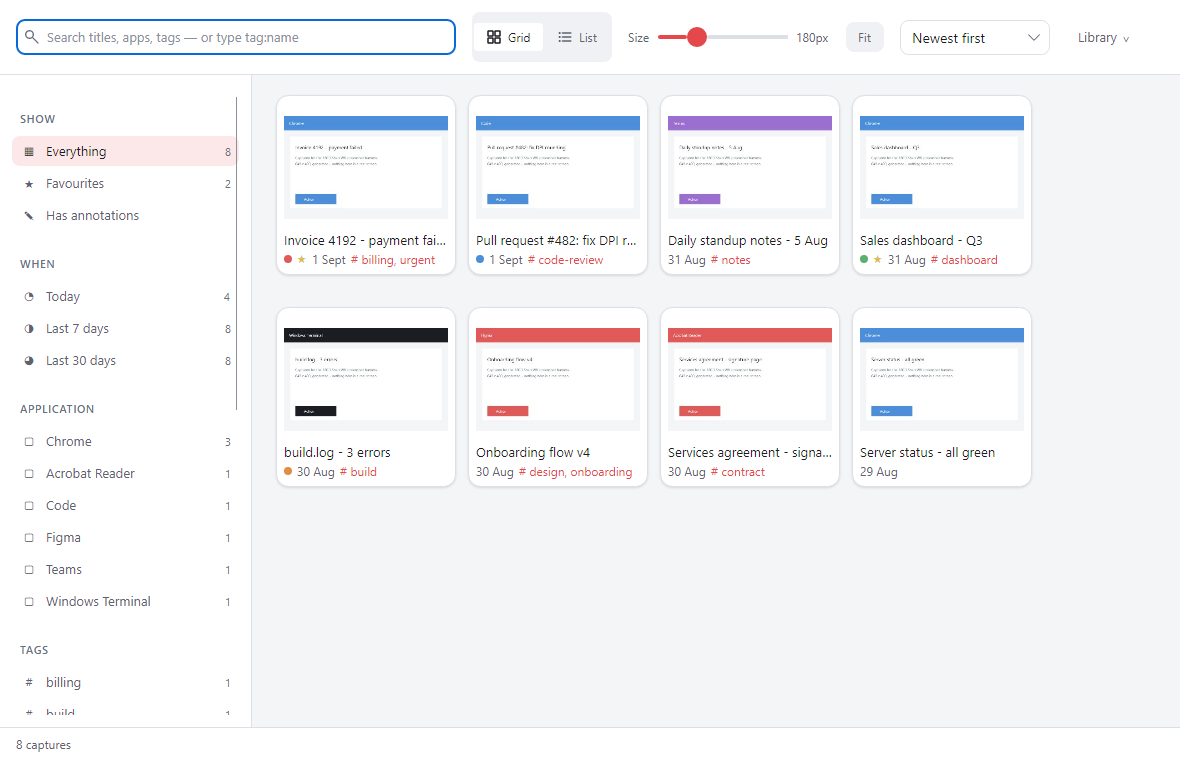
Every capture is read for text on your machine, using Windows' own recogniser. Search for a word you saw in a screenshot and get the screenshot.

  • Search titles, apps, tags and the words in the image
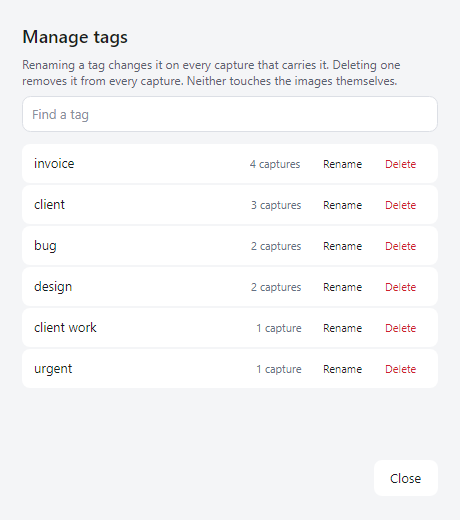
  • Type tag:invoice to narrow to one tag, or several at once
  • Tags are written into the image file, so they survive and travel with it
  • Windows File Explorer can see those tags too

Record the screen

When a picture will not do. Recordings are trimmed and reviewed in the app, and can be transcribed on your machine so the words are searchable.

  • Cut segments out and keep the rest
  • Export a clip as a GIF
  • Spoken words become searchable text

A library, not a folder of noise

Every capture is indexed as you take it: what app it came from, what the window was called, how big it is.

  • Tags, colour flags, favourites and collections
  • Rules that tag new screenshots for you, with a record of what they did
  • Delete things older than a date, on purpose, with a warning first
  • Back up and restore your labels as a readable file

The privacy bit, in plain words

A screenshot tool sees everything you look at. Passwords, client records, medical details, half-written emails. That is a serious amount of trust to ask for, so here is exactly what happens.

Captures are saved as ordinary files in a folder you pick. The index that makes search work is a database beside them, on the same disk. Text recognition runs on your machine using a component that ships with Windows.

  • No account, no sign-in, no licence server
  • Nothing is uploaded, ever, including crash information
  • This website has no analytics and loads nothing from anyone else
  • Uninstalling leaves your screenshots exactly where they are

Download

ScreenSnip 0.4.44

148 MB · Windows 10 and 11 · 64-bit

Download the installer

Installs for the current user. No administrator needed.

What happens when you run it

Windows will show the publisher as 180 Degrees IT Solutions. That is us. The installer and everything it puts on your machine are signed.

Check the file is our file

Open PowerShell where you saved it and run:

Get-FileHash .\180DSnap-stable-Setup.exe -Algorithm SHA256

It should print:

647c61419a7c6068cc6f3e91034c8ee1c51f8f9fbcb669c6673bcb6555323558

If it prints anything else, do not run it, and tell us.

Updates arrive on their own. The app checks quietly in the background and asks before installing anything.

Questions

Is it free?

It is free while it is in preview, with no feature held back and no trial clock. If that changes, it will change for new installs, and it will be said plainly here rather than discovered by somebody mid-job.

Does anything I capture get uploaded?

No. There is no upload path in the product at all. Captures are files on your disk, the search index sits beside them, and text recognition happens on your machine using a component built into Windows. The app talks to exactly one server, to ask whether a newer version exists.

Do I need an account?

No. There is nothing to sign into and nothing to activate. Install it and it works.

Windows says the publisher is 180 Degrees IT Solutions. Why not ScreenSnip?

Because that is who holds the code-signing certificate, and Windows shows the name on the certificate rather than the name of the product. 180 Degrees IT Solutions makes ScreenSnip. Showing you the real signer is the honest thing for Windows to do, even when it is momentarily confusing.

Does the blur really remove the information?

Yes. Blur, pixelate and redaction change the actual pixels rather than drawing a shape on top of them, so the original cannot be recovered from the exported file. The app also throws away anything it had already read out of those pixels, including the words in its search index and any cached thumbnail made from the old image.

How does searching inside a screenshot work?

After a capture is saved, the app reads any text in it using the recogniser that ships with Windows, and stores those words in its local index. Searching looks at the window title, the application, your tags and that recognised text together. Nothing is sent anywhere to make it work.

If I lose the app's database, do I lose my tags?

No. Tags, colour flags, favourites and collections are written into the image file itself as standard metadata. Delete the database, rebuild the library from your folder, and they all come back. It also means a tagged screenshot carries its tags to another machine, and that Windows File Explorer can see them.

Can I control it across a company?

Yes. There are Group Policy templates for the settings that matter, including whether updates are allowed, where they come from, and locking the privacy scan on so it cannot be switched off locally.

What happens to my screenshots if I uninstall?

Nothing. They are ordinary image files in the folder you chose, and the uninstaller does not touch them.

Which versions of Windows does it run on?

Windows 10 and Windows 11, 64-bit. There is no macOS or Linux build.